Reviews

I was seriously ill for a month with flu then pneumonia.  During this time I managed to do some reading but I couldn’t string string together sentences worth a damn so a pile of books for review accumulated.  Since I got better I’ve had dramas galore and I’ve been procrastinating.  I hate missing a deadline, so if there isn’t anything I can do about it, I tend to bury my head in the sand by pretending the deadline didn’t exist.  I know this is crazy as I’m the only person setting deadlines for Dark Matter, but I never claimed to be logical like Spock.  This is why these reviews are coming in a flood now: I am officially and really catching up. :P

Starting at the top of the pile, so in reverse order:

The Outcast Blade cover

The Outcast Blade by Jon Courtenay Grimwood.
A historical paranormal fantasy with Machiavellian politics, adventure, werewolves and romance, set mostly in Venice, Italy in about the 17th century or thereabouts (my history is rusty).  I loved the first in this trilogy; setting werewolves in a historical setting gave them a freshness: urban fantasy with werewolves is getting a bit same old, same old.  Grimwood created such a sense of place that Venice was almost a character in her own right, although I’ve been assured by friends who’ve been that the city stinks to high heaven.  The smell doesn’t quite come through. ;)

I am somewhat confused about what Tycho, the male protagonist, is.  Sometimes it seems he’s a vampire and at other times he seems to be a werewolf, but he’s not the same creature as others who are definitely werewolves.  It could be that Tycho’s self-discovery is made alongside the reader, which is why I haven’t Wikipedia’ed or googled it.  I try to avoid spoilers where practical.

The second in the series was a really good Act II, well paced, carrying the plot forward, developing the relationships further.  My only criticism is Grimwood’s habit of splitting sentences in two. So there’s a full stop between clauses.  I found this quite distracting.  Act I was reviewed from an ARC (Advanced Reader Copy) but Act II wasn’t an ARC so criticisms of the text are fair.

The hiatus at the end of Act II is a good one, with a partial resolution to tide the reader over until next year.  I think this series will appeal to Game of Thrones fans although it’s not as hefty nor does it have as many characters.  Highly recommended.
Legacy of Lord Regret cover

The Legacy of Lord Regret by Sam Bowring (whom I interviewed) is high fantasy with black and white characters who are almost caricatures.  While I prefer characters who are shades of grey (as in Sam’s first trilogy, apparently) these characters are interesting because when they kill one another they absorb the victim’s power – and part of their personality.  Thus Sam’s characters are changing, and those changes aren’t just incidental as a result of the plot, they are instrumental and will, I expect, cause shifts in the plot.   This is book one of a duology (two book story arc).  The second book is the Lord of Lies, which is also out, so no waiting on the conclusion to this story – unless you’re a reviewer/interviewer trying to keep up.  My copy is in my TBR pile.

The nature of this novel is such that I need to read the conclusion to decide how enthusiastic I am about it: I really want surprises, twists and more greyness, but in its present form it’d make a popular comic book or movie.

If you’re trying to decide whether to give this one a go, I recommend listening to Sam’s interview.  (Note: Sam had the flu so his energy levels were low.)  Sam talked about how his favourite character was the guy who tortures people, and that’s played for comedic value.

The Drowned Cities cover

The Drowned Cities by Paolo Bacigalupi is another book set in a world not unlike Windup Girl, which I loved. Drowned Cities is the story of two teenagers.  Mahlia is a half-caste who had her right hand chopped off, and Mouse is an optimistic kid who rescued Mahlia before the story began.  They accidentally disturb Tool, a genetically engineered soldier who is part human, part animal.  The story is set in southern USA after climate change has caused seas to rise.  The remnants of their world are not unlike war-torn areas in Africa or the Middle-East, creating both the setting and the plot for this story.  Bacigalupi brings this culture of war to life vividly, challenging people to think, to really think, about what is going on in the world today.  Highly recommended dystopian SF.

deadlocked cover

Deadlocked by Charlaine Harris is the second-last in her Sookie Stackhouse series upon which True Blood is loosely based.  It’s paranormal fantasy with werewolves, vampires, shapeshifters, fairies, witches, telepaths, you name it.  Sookie, her family and friends have been through lots of adventures, murders, threats, sex, drugs and rock’n'roll.  As the second-last in the series, Charlaine has been wrapping up story lines, closing off characters and she’s leading in to the final story.  I’m looking forward to the conclusion.

This is not a ‘jumping on’ point for the series; if you are a newcomer, I recommend you start with book one.  Overall if this series was food, it’d be chocolate; it’s overall light and escapist fun.

Songs of the Earth cover

Songs of the Earth by Elspeth Cooper is epic escapist high fantasy based on Nordic mythology about the Wild Hunt.  The protagonist, Gair, is a young man of mysterious origins with extraordinary magical powers.  Narrowly escaping a death sentence due to political machinations by people he’s never met, Gair travels to an academy for students of magic where he makes friends for the first time and aggravates new enemies.

The hero with obscure origins finding himself, a forbidden romance, betrayal from within, destiny: these are common tropes reflecting influences from a variety of beloved authors.  Elspeth weaves these threads together well, appealing to fans of iconic authors who’ve been waiting for another high fantasy ‘fix’ and to fans of fantasy who haven’t read those who’ve gone before.  Children who enjoyed Alan Garner’s The Weirdstone of Brisingamen and Ursula le Guin’s Earthsea series (the books, not the Anime nor the TV series) will enjoy Elspeth’s Wild Hunt as adults.

Songs of the Earth is so popular it was shortlisted for a Morningstar Award  in 2012, which is a ‘best fantasy’ award for a new author.  Book two, Trinity Rising, is out already.  I think book three is due out next year.
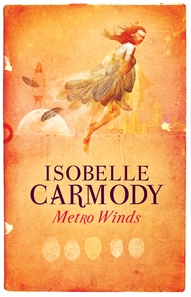
metro winds cover

Metro Winds by Isobelle Carmody is a series of fairy tales for a YA or adult market (not for children), presented as short stories and one novella in one volume.  Most of these are original stories with one notable retelling of a classic tale, reimagined in the most creative way I’ve read to date.  It’s very difficult to talk about short stories without giving away spoilers so I recommend listening to Isobelle’s author talk and reading for more information: she presents Metro Winds beautifully, better than I, plus – added bonus – she explains why it’s been so hard for her to finish the Obernewtyn Chronicles.

I thoroughly enjoyed these tales even though I’m usually dissatisfied with the brevity of short stories.  My only reservation was one of the later stories with a male protagonist, which somewhat repulsed me, but others will rave about it.  Highly recommended.
shadow of night cover

Shadow of Night by Deborah Harkness is the sequel to the best-selling Discovery of Witches.  Discovery is fantasy set in contemporary times with vampires, witches, daemons and all sorts of other supernatural folk.  Discovery ensnared me in the beginning with Diana Bishop, an academic, researching in the Bodlean Library in Oxford.

By the end of Discovery I had a few reservations due to what I felt was excessive introduction of magic: Diana’s house was sentient and had ghosts.  Although Diana was supposed to have grown up ignorant of the supernatural, she apparently had a relationship with this house knowing about its magical abilities and habitually magically disposed of her hair and nail clippings to prevent people finding her DNA.  Nonetheless, Discovery captured me and carried me through its romance and wild ride.

In Shadow the protagonists, Diana Bishop (a witch) and her husband Matthew Clairmont (a vampire) travel back in time to Elizabethan England so that Diana can find a mentor to teach her to control her budding powers.  Instead of staying focused, Diana and Matthew hare off after a missing text with the intention of securing it and taking it forward in time.  Although they’re intelligent people, Diana and Matthew ignored all the problems and potential paradoxes inherent in what they were doing.

I love time travel stories and I’m happy for them to engage with paradoxes or to circumnavigate paradoxes, so I’m very forgiving.  The problem with Shadow is the puppet master feel of so many events.  Mary, Diana’s new friend, shows up in the nick of time unexpectedly and does exactly the right thing without legitimate foreknowledge or a reasonable explanation afterwards. Phillipe, Matthew’s father, gives Diana a really hard time then suddenly does a backflip without justification for the contrasting behaviour.  I felt that Diana and Matthew lingered too long in historical Europe just to place them in a parade of historical events and European courts, winking at the reader all the while.

A year ago I would have read Shadow of Night, recognised some of its flaws and still loved it unashamedly.  This year I enjoyed it but that critical faculty switched on during reading made me almost feel guilty for enjoying it, puppet masters and all.

If you enjoy full on magical fantasy populated with a myriad of supernatural folk plus a generous dollop of historical fiction thrown in, and you’re happy not overly analysing the story, then Shadow of Night is a highly recommended read.  Just throw yourself in and enjoy the ride.
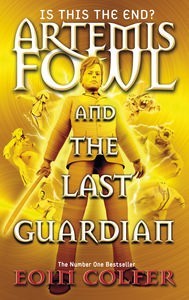
Artemis Fowl and the Last Guardian cover

Artemis Fowl and the Last Guardian by Eoin Colfer is the final in the comedy adventure Artemis Fowl series that my son grew up with, reading and rereading since primary school.  Of all the books my son read growing up, this series stands out as a series he still loves without reservation, aged 19.  I’ve read the full series as well, although not nearly as many times.

Artemis Fowl is a boy genius who grew up in a crime family.  After kidnapping a fairy, Captain Holly Short of Leprecon – the fairy police – the following adventures build an uneasy truce and later friendship between Artemis and the fae.  In this, the final instalment of the series, Artemis is on the cusp of adulthood.  As with Harry Potter, Artemis and his adventures have ‘grown up’ over the course of the series, aiming at a little higher age group, but I think the later books are still suitable for advanced primary school readers.  I think the entire Artemis Fowl series is suitable to be read to children too young to read themselves as stories like these will inspire a love of books.

Every Artemis Fowl book looks at current issues in the world, often from a a conservationist perspective without being preachy.  This final book explores the idea of obsolete conflict – like the Japanese soldiers stranded after World War II, still fighting the war because no-one told them it was over.  Eoin discusses this in our interview.  As always, Mulch Diggums (a very original dwarf) farts his way through adventures, slap-stick comedy routines abound like parts falling off zombie minions at inconvenient moments, camaraderie and high jinks abound.

I’ve enjoyed this series so much so that I recommend it to adults even if you don’t have children to whom you read.  If you read stories to children, this series is a must have.
blood storm cover

Blood Storm by Rhiannon Hart is a YA paranormal romance starring Zeraphina, a princess whose older sister married the crown prince of another country, and Rodden, a commoner who rose to a position of power very young.  Both Zeraphina and Rodden have been infected with the blood of Lharmellians, the precursor to turning them into Harmings (human vampires).  As Zeraphina and Rodden struggle with side effects and struggle to remain human, retaining their will, they are intent on opposing Lharmellians and Harmings, whose politics may be more complex than they first appeared in Blood Song, the first in this trilogy.

In this, the second novel in the trilogy, Zeraphina and Rodden do a Cook’s tour of the countryside, learning more about each other and the Lharmellian conflict.  Blood Storm has an episodic feel as if written for TV and the different locations are the ‘location of the week’.  I particularly enjoyed the trip into the desert, which wasn’t just an excuse to feature belly dancing.  ;)

Zeraphina is pursued by a prince of another country to be his bride.  This courtship is my least favourite portion of the book as the prince is a bit of a caricature villain, missing only twirling black mustachios, but it’s a small portion of the story.

Revelations of Rodden’s past confirm that he’s not some mysterious prince in disguise, a somewhat time-worn trope.  Rhiannon has more revelations planned for book three, which she discusses, at least in part, when she talked to me just before Blood Storm‘s launch in August.

Blood Song is an original, captivating YA paranormal romance.  Blood Storm is not quite up to the same standard, but it’s still a solid second book for a new author.  I look forward to reading the conclusion.

whispers underground cover

Whispers Underground by Ben Aaronovitch is an urban fantasy comedy with Harry Potter-esque Peter Grant working as a policeman in contemporary London.  I started this review when I only had the flu, before it developed into full-blown pneumonia, but I didn’t quite manage to finish it.  Here goes:

Peter Grant works in The Folly, which is a special branch of London Metropolitan Police dealing with the supernatural in present-day London so everyone else can live in denial.  Lesley May, his cop-buddy and erst-while lust-interest, had her face ripped off in a previous novel.  Although Lesley is still intelligent, more capable than Peter and physically attractive apart from her lack of face, Peter has issues about Lesley’s looks.  Peter is shallow and somewhat slow on the uptake, as evidenced by Lesley overtaking Peter in magical studies as well as always having been the better police officer.    Although technically on medical leave, Lesley is actively involved in this novel to some extent.

Whispers Underground is a detective policing story told from Peter’s point of view; Peter is summoned to investigate a murder with a hint of magic.  Peter meanders around, furthering the investigation partly through luck, partly through his increasing skill and partly with the help of old friends.

Peter, like Aaronovitch, is a bit of a geek fanboi, so his detailed knowledge of architecture and the intricacies of London are woven into the story alongside countless one-liners spoofing geek culture with an emphasis on Lord of the Rings.  This is Big Bang Theory without making a mockery of the geeks, although a little more respect for Lesley – and, by default, for all women – would be appreciated.  At times Peter has the maturity of a teenager while at other times he’s considerate and thoughtful: I hope that this minor story thread is part of Peter growing up.

The humour ranges from dry one-liners to somewhat slap-stick physical comedy to intricate social comment like the reporting about Asylum seekers eating a snow plow (you have to read it!); thus Aaronovitch successfully casts a net for a wide audience.  I’m really enjoying this series.  Highly recommended as urban fantasy comedy adventure thriller.

I also expect romance to come later, when Peter gets his head out of that very dark place upon which he sits. :P  Although it’d probably have to be initiated by Lesley.

SFF Authors: submission opportunity

CALL FOR SUBMISSIONS:

Harper Voyager Announces Global Digital Publishing Opportunity
for Debut Authors

 NEW YORK, NY - September 12, 2012: In this time of accelerated evolution in the field of digital publishing, the editorial leaders of Harper Voyager in the United States, United Kingdom and Australia are delighted to announce an exciting joint venture that will offer talented aspiring writers the chance to join the global science fiction and fantasy imprint.

 For the first time in over a decade, Harper Voyager is offering writers the chance to submit full, unagented manuscripts for a limited two-week period. The publisher is seeking new authors with fresh voices, strong storytelling abilities, original ideas and compelling storylines. Harper Voyager is home to some of the biggest names in science fiction and fantasy, including George R. R. Martin, Kim Harrison, Raymond E. Feist, Robin Hobb, Richard Kadrey, Sara Douglass, Peter V. Brett and Kylie Chan, among others.

The submission portal, www.harpervoyagersubmissions.com, will be open from the 1st to the 14th of October 2012. The manuscripts will then be read and those most suited to the global Harper Voyager list will be selected jointly by editors in the USA, UK and Australia.  Accepted submissions will benefit from the full publishing process: accepted manuscripts will be edited; and the finished titles will receive online marketing and sales support in World English markets.

Voyager will be seeking an array of adult and young adult speculative fiction for digital publication, but particularly novels written in the epic fantasy, science fiction, urban fantasy, horror, dystopia and supernatural genres. Submission guidelines and key information can be found atwww.harpervoyagersubmissions.com.

The submissions and digital publications are a joint, global effort by Harper Voyager, spearheaded by Deputy Publisher Director Emma Coode in the United Kingdom, Associate Publisher Deonie Fiford in Australia, and Executive Editor Diana Gill in the United States.  The three editors note that: “No other publishing company has done a coordinated submission period for unagented authors across three continents, and all of us at Harper Voyager and at HarperCollins Publishers are absolutely thrilled to be launching this huge opportunity. We look forward to discovering and digitally publishing many new exciting voices globally at Harper Voyager.”

For more information about the publisher, please visit: www.harpervoyagerbooks.com.

ABOUT HARPERCOLLINS PUBLISHERS

HarperCollins, one of the largest English-language publishers in the world, is a subsidiary of News Corporation (NYSE: NWS, NWS.A; ASX: NWS, NWSLV). Headquartered in New York, HarperCollins has publishing groups around the world including the HarperCollins General Books Group, HarperCollins Children’s Books Group, Zondervan, HarperCollins UK, HarperCollins Canada, HarperCollins Australia/New Zealand and HarperCollins India. HarperCollins is a broad-based publisher with strengths in literary and commercial fiction, business books, children’s books, cookbooks, mystery, romance, reference, religious and spiritual books. With nearly 200 years of history HarperCollins has published some of the world’s foremost authors and has won numerous awards including the Nobel Prize, the Pulitzer Prize and National Book Award, the Newbery Medal and the Caldecott. Consistently at the forefront of innovation and technological advancement, HarperCollins is the first publisher to digitize its content and create a global digital warehouse to protect the rights of its authors, meet consumer demand and generate additional business opportunities. You can visit HarperCollins Publishers on the Internet athttp://www.harpercollins.com.

 # # #

Harper Voyager Guidelines for Digital Submission

 Keen to become a Harper Voyager author? Here’s your chance to join the imprint that publishes some of the biggest names in fantastic fiction – George R. R. Martin, Kim Harrison, Raymond E. Feist, Robin Hobb, Richard Kadrey, Sara Douglass, Peter V. Brett and Kylie Chan – to name but a few.

For the first time in over a decade, Harper Voyager is opening the doors to unsolicited submissions in order to seek new authors with fresh voices, strong storytelling abilities, original ideas and compelling storylines. So, if you believe your manuscript has these qualities, then we want to read it!

We’re seeking all kinds of adult and young adult speculative fiction for digital publication, but particularly epic fantasy, science fiction, urban fantasy, horror, dystopia and supernatural. For more idea of the type of books we love to read and publish, check out our authors and their titles atwww.harpervoyagerbooks.com

 Submissions for digital originals will be open for a limited two-week period from 1st to the 14th of October.

So, follow these easy guidelines and move one step closer to making your dreams come true …

 How To Submit A Manuscript

To submit, go to www.harpervoyagersubmissions.com and follow the instructions to fill out the form and upload your manuscript.

Due to time constraints, we will not be able to respond to every query. If you do not receive a response after three months, unfortunately that means your story is not right for us this time.

 Submissions FAQ

How long does my book need to be?

We are looking for full-length manuscripts only. A full-length manuscript needs to be more than 70,000 words, and ideally we are looking for manuscripts between 80,000–120,000 words.

 Can I submit a manuscript that I am still working on?

No. Please only submit full-length manuscripts that are completed and polished.

What font/margin/size should I use?

Your formatting choices are up to you. As long as your manuscript is double-spaced and readable, it’s acceptable. We prefer Word or RTF, and legible, sans-serif fonts.

Can I submit more than one manuscript?

Yes, you can enter more than one manuscript but you will need to fill out the form atwww.harpervoyagersubmissions.com for each submission separately. If your work is a trilogy or series, please only submit the first manuscript.

Can I submit someone else’s material?

No. The manuscript must be your own original work.

Will you accept a manuscript even if the subgenre isn’t listed?

Yes, on the submission form, choose “other” and write in your subgenre.

I’m an agent. Should I use this to submit my client’s manuscript?

No, this submission form is for authors only. Agents should pitch and submit projects in the usual fashion.

Can I submit if my manuscript is under consideration with another publisher?

No. Manuscripts that are being considered by other publishers are not eligible for submission.

Do you accept manuscripts that have been previously published, including self-published?

Yes, we will consider work that has been previously published if the author has retained full volume rights or had full volume rights revert to them. Please provide the publication details.

I have submitted my book to Harper Voyager in the past and it has been declined. Can I resubmit?

If a manuscript has previously been submitted and declined for Harper Voyager, please do not resubmit unless it has been extensively rewritten. You are welcome to submit other works, however.

Which editor should I address my submission to?

There is no need to specify an editor. Your submission will be read by the global Voyager team in Australia, UK and US.

Will I be notified when my manuscript is submitted?

Yes, you will receive an email acknowledging receipt of your submission. Please check your junk email filter for this automated email. If you do not receive an automatic response, please email us atvoyagersubmissions@harpercollins.com with the title and date of your submission.

How long will you take to respond?

Due to the volume of submissions, we will only be able to contact you if your project is the right fit. If you have not received a response in three months time, unfortunately your project wasn’t right for our current list.

 Will there be any feedback?

Unfortunately due to the volume of submissions we will not be able to provide individual feedback or comments on submissions.

Can I submit my manuscript after the deadline?

We will be accepting submissions between 1st to the 14th of October, 2012. Unfortunately at the moment we cannot accept any late or early submissions outside of these times.

Will you publish my book into print?

We are looking primarily for e-only titles. There is the possibility that submissions will be published in print as well.

Frequently Asked Questions about Harper Voyager Digital

 Why is Harper Voyager embarking upon a digital publishing program? Why now?

We believe the timing is perfect for Harper Voyager to publish digitally. We’ve already been publishing digital originals from our existing Harper Voyager authors, and are thrilled to expand this wider to welcome new authors and voices to Harper Voyager. The growth of eReaders and e-books has created an exciting new opportunity that allows us to begin increasing the number and diversity of our speculative fiction list. And speculative fiction readers are the most savvy early adopters so we’re keen to provide our readers with the best ebooks possible.

 How is the Harper Voyager digital list different from Harper Voyager Books?

Harper Voyager has a long history of publishing fantastic speculative fiction, including authors like Robin Hobb, Ray Feist, George R.R. Martin, Kim Harrison, Kylie Chan, Richard Kadrey, Fiona McIntosh, Peter Brett and Sara Douglass: our editorial staff and sales/marketing/publicity force are highly respected, and Harper Voyager authors benefit from those existing talents, platforms, and relationships.

The Voyager digital list is growing from our existing publishing program. We’re always looking for ways to grow our authors in a marketplace rife with new opportunity. We see the digital list as a fantastic opportunity to find exciting new writers and reach more readers than ever before.

Our enthusiastic editorial team acquires content for both our print and digital lists and we are passionate genre fans. The Harper Voyager digital lists offer similar benefits to authors as the print list: each Harper Voyager e-book will receive a distinctive cover treatment. Authors will receive the benefit of editorial structural and copyediting advice from experienced editors. During the publication cycle, the books will receive support from Harper Voyager’s marketing and publicity professionals; and the e-books will benefit from our proven, strong relationships with all e-book channels and online retailers.

 How many titles per month will you release?

Currently, we are looking to acquire enough content to release a new Harper Voyager digital title each month.


Where will Harper Voyager’s digital titles be sold? Will Harper Voyager e-books be distributed globally?

Every Harper Voyager digital contract will include World English language distribution, so we can deliver these e-books everywhere around the world where English-language novels are sold.  Our Harper Voyager e-books will be available at every e-retailer, and readers will be able to download them onto every portable reading device and platform sold today…and tomorrow, too.


What is the submission process? Where can I find the Submission Guidelines?

All non-agented manuscripts should be submitted at www.harpervoyagersubmissions.com ] Please note the detailed instructions on submission guidelines before sending your documents electronically. You can find our submission guidelines at www.harpervoyagersubmissions.com as well.


What types of submissions is Harper Voyager interested in?

Voyager is looking for authors with a fresh voice, strong storytelling abilities, original ideas and a compelling storyline. If you believe your manuscript has these qualities, then we want to see it!  We’re actively seeking speculative fiction genres, especially epic fantasy, science fiction, urban fantasy, horror, dystopia, supernatural and YA.


Can existing Harper Voyager authors also submit to Harper Voyager digital?

Of course!


If a debut author is published under the Harper Voyager digital imprint; is there a chance to be published in print as well?

Yes, there is the possibility that submissions will be published in print as well.


Will my work be copyrighted?

Each title receives individual copyright, retained by the author, as is the norm for all Harper Voyager titles.


Is Harper Voyager publishing fiction only?

Yes, we are only looking for speculative fiction manuscripts.


Will manuscripts be edited and copyedited before publishing?

Yes. Just as with our print titles, each Harper Voyager digital project will be assigned to an individual Voyager editor, and will go through a comprehensive content and copyediting process.


Will Harper Voyager titles benefit from Voyager Publicity and Marketing?

Yes. We will support our digital Harper Voyager titles with comprehensive publicity/marketing campaigns, marketing each title, using the digital landscape to strongly support this fantastic line of digital-first publications.


Is Digital Harper Voyager a Custom/Vanity Publisher?

No. In acquiring for Harper Voyager digital, we carefully curate submissions and edit accepted manuscripts in the same fashion as all of our Harper Voyager titles. The digital list will benefit from Voyager’s editorial, marketing, publicity and sales platforms. And getting all these services at no cost to the author is the benefit of publishing with Harper Voyager.

Our digital original submission period is only open from 1 October through 14 October, so visitwww.harpervoyagersubmissions.com and move one step closer to your Voyager dreams.


Return to home page

Hell: a movie review

Hell: a review by Elizabeth Vinton

Hell cover

Hell is the first movie that I have watched that has Roland Emmerich attached to it, since his ‘remake’ of Godzilla (for ‘Hell’, he is executive producer).

Those who are Emmerich fans, at least of his Hollywood films, I think may be pleasantly (or perhaps unpleasantly) surprised by the lack of epic scale to this film – it may be a deliberate move on his part to move away from larger scope films, but remain supportive of the ‘(post)apocalyptic’ theme he seems to be fascinated by.

Those who may be put off from Hell due to concerns over Emmerich’s involvement should give the film a try as it is far from his style – I get the impression that like Del Toro and many other directors, he has supported an upcoming director’s (Tim Fehlbaum) project. His name is definitely touted on many of the advertisements for the film, I would say in an effort to mass promote it internationally – especially as it’s a German film, in German.

The premise is simple – it is 2016, and Earth’s surface has become inhabitable due to increased temperatures, exposure during the day causes very serious burns within hours, the light from the sun blinding. Even the night is brighter but allows safer travel for those looking for food and water.

We follow three people, two sisters and a man they have befriended along the way, as they follow the hope that a bird in the sky brings them of water, of a place where they can have some sort of life.

The shots of the bleak (and yet in some scenes, beautiful) landscapes, and of the sparse existence they have made in a car, thickly papered to keep the deadly sun out, is very evocative. The world they survive in, whilst not explained in any great detail, is told in the images shown to the viewer rather than any form of narrative.

The difference between dusty abandoned interiors, decaying signs of an old way of life and the white purity of the extreme daylight hours depicts the harsh and vulnerable nature of the character’s position. The fields filled with dead cattle and the forests of ghost like trees, stripped of foliage are horrifying to behold.

This film is visually stunning, the cinematography especially in scenes going from dark to light is amazing to watch. As the viewer you are sometimes also put at a disadvantage in regards to sight adding to the tension via excellent visual effects.

Sadly however the tale told within this amazing landscape is not very original, not very complex and there is not a lot of character development.

I found myself only liking one character the entire movie, Tom, whom the threesome find in an abandoned gas station and take with them on their journey. He carries scars that hint of interesting stories not told, and has a very good survival instinct that comes from experience. But we find out very little about him and his past.

In fact overall we come into the middle of a story in terms of the three main characters – which I felt was to the detriment of the plot. In all the time the viewer spends with them the entirety of the film, I really don’t think anyone, despite the terrible nature of events that happen, develop any further than how they first appear. They seem ‘untouched’ by what they go through.

The ‘bad guys’ of the film, also are fairly bland, and the scenes with them take the movie from a post apocalyptic thriller into the realm of predictable slasher horror.

The film goes from slow burn, full of tension, to out and out action, but in the end the tale is short, and very simple. I found this to be a shame as the world created to tell this story in was visually set up extremely well and had so much promise in it.

All in all, if you are looking for a film that contains a simple story told within a wonderful visual medium, and you are happy for it to go from apocalyptic thriller to horror action, you will enjoy this.

I found it had potential that was not realised within such a short, simple plot, but would be interested to see what the director does next as he has a great visual eye.

Books received

books received

I received a couple of books last week but with all the dramas in my life, I forgot to post them.  Then hubby came home bearing not one, not two, but four parcels of books today (one in each parcel), reminding me that I’m behind.  So here is the round-up of books received since last time.

Force unleashed 2 cover

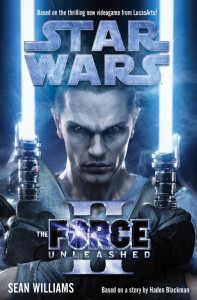
This beautiful but lonely hardcover is going to require companions; I may have casually mentioned my need – one or thrice – for matching books; the minion is waiting for his next paycheck.

Whenever I read a hardcover, I put the dustjacket safely to one side beforehand to prevent unsightly dings and tears, while I gently nurse my precious, my precious…  And that’s when the book isn’t autographed.

Force unleashed 2 cover

I bought a limited, signed edition of a book the minion wanted to read once; he has now swiped my kindle for some strange reason…

Alveridgea cover

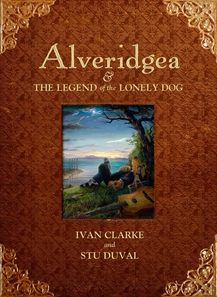
Alveridgea is beautiful.  Hardcover, gold embossed lettering, faux embossed corners, with a richly coloured central picture inset and raised up.  I haven’t read the book yet, but it’s appearance leads me to hope it will be one of those treasured volumes that is lovingly perused again and again.  The pages are not your normal paper colour, but are slightly yellow.  Exquisite greyscale pencil drawings and sepia pseudo-photos are scattered throughout.  Ornate lettering marks the opening of each chapter.  Contrasting typeface highlights the occasional poem or insertion.   The only thing missing is that wonderful ‘old book’ smell.

total recall cover

No self-respecting SF fan would admit to being ignorant of the fact that Total Recall is out in the cinema.  I’m just waiting for the minion’s next contract to arrive, then I’m scraping my pennies together for a trip to the cinema (cinema is a luxury dole bludgers like us can’t afford).  I’ve never actually read Total Recall before, nor, indeed, most of Philip K Dick’s stories.  This will be an education.  The print size for this collection of short stories is small but dark, contrasting well with the page, and the cover falls open easily.  Using the CCTV lent to me by Vision Australia, I anticipate little difficulty reading the book (note: I’m vision impaired aka blind as a bat).

Tiger's destiny cover

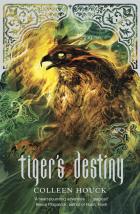
This is the fourth and, I believe, final book in the tiger series by Colleen Houck.  Jade Hounsell has been reviewing this series, and I’m hoping she has time to do this pretty romance novel justice.  The cover stands out among paranormal romance novels with its focus on a dynamic predatory bird rather than a pretty girl; the colours are dynamic and vibrant.  The print is on the small side.

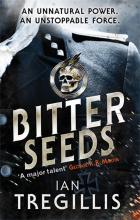
Bitter Seeds cover

I’m not sure if I recall seeing this book before it arrived.  Bitter Seeds has recommendations from George R.R. Martin on the front cover and Cory Doctorow on the back cover, so you’re not prying this one out of my cold dead hands.

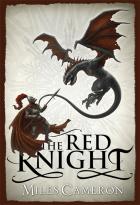
the Red Knight cover

This arrived as an uncorrected manuscript proof and it’s a brick, surprisingly heavy.  I like the cover as it’s striking and unusual even though my personal preference would be for a better tonal range in the featured characters.  A debut fantasy novel, this one comes from ‘the team who launched Joe Abercrombie, Patrick Rothfuss, Scott Lynch and Elspeth Cooper‘ and is recommended for Abercrombie’s and George R.R. Martin’s readers.  The media sheet spruiks the author as a re-enactor and weapons specialist, so I hope the fight scenes will be realistic.  It’s been months since I read Dance with Dragons and even longer since I read The Heroes; I think I need me a fix.

Can someone please make a 26 hour day and 8 day week?  With the extry time just for me to read?

Oh. My. God.

Yesterday an Australia Post ticket was waiting in Dark Matter’s post office box, telling me to collect a parcel.  Today the minion brought the parcel home.  It’s usual for these types of parcels to be large bundles of books or, disappointingly, a big box with one book and a lot of packaging.  Not so today.  I received this care package from Hachette Australia.

Hachette's parcel

At this point I think my jaw about hit the floor because I had no idea what was inside, but it was clear this wasn’t the ‘usual’ pile of review books.  (Did I ever mention how spoilt I am?  I <3 Hachette.)

I peered inside…

inside the care package

Now my jaw needed to be picked up off the floor.  Wha-at?  A MANUSCRIPT???  AND A BOTTLE OF WINE???  And other stuff too?  Breathlessly I reached in, withdrawing item after item, examining my epic loot.  I took several photos as the contents of this Bag of Holding emptied, but in the end I arranged them for one photograph.

care package contents

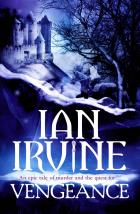
The first item to come out was a copy of Ian Irvine’s Vengeance, the first volume of his latest trilogy about a girl living in a dystopian fantasy society.  Next was the envelope with the notation ‘Eat Me!’  You can see all the sweets that were inside.  So I didn’t have an accident I withdrew the bottle of wine next.  Last but by no means least, I gingerly extracted the first manuscript I have ever been given, a copy of book 2 of Ian Irvine’s trilogy, Rebellion.  Did I ever mention that I collect books?  I’ve never had the privilege of owning a manuscript copy before, even though my collection of autographed books is gradually growing.

When I drew out the bottle of wine I was careful because breaking a bottle  of any vintage would have been tragic; this bottle, from the Wine Men of Gotham, is worthy of display!  I’m torn between keeping it and drinking it.  I think I’ll save it up for a special occasion, drink it and then keep the bottle.

Wine men of Gotham

Recently I’ve received other books in the post as well.  The nightmare that is looking for a day job as a disabled person has distracted me lately, so my apologies for not posting these sooner.

books received

Books received lately in absolutely no order at all:
*  Stormdancer by Jay Kristoff (Japanese Steampunk!!!),
*  Throne of Glass by Sarah J. Maas: from the cover it looks like fantasy with a kick-ass heroine
*  Besieged by Rowena Cory Daniells: more on this in a moment
*  Lady of the Shades by Darren Shan: a dark supernatural thriller
*  Maze Cheat by B.R.Collins: a kids’ book.  I’d link this but I can’t find it on the publisher’s website – it’s 2 weeks until launch, so maybe that’s why.  It’s put out by Bloomsbury on 1 September 2012.
*  Lord of Lies by Sam Bowring: part two of Sam’s duology.  I interviewed Sam last week about his work in comedy and his novels.  His published novels for adults aren’t comedic, although that could change for the future, he is looking to explore possibilities.

Besieged cover

Besiged has a special place in my heart: I interviewed Rowena last year.  Rowena talked about her novels, teaching storytelling and about creating the artwork for her covers and book trailers: it’s a family affair.  Rowena, sweetie that she is, sent me this copy personally, complete with autograph *hugs book*

Besieged book plate

After a really shitty week – the shittiness has nothing to do with Dark Matter and the SFF community – things are picking up this afternoon, both because of dealing with the problems and because I’m feeling the love from my peeps: you, the SFF and bookish community.  Thanks all!

Judging a book by its cover

There’s an old saying: ‘Don’t judge a book by its cover.’  This can be taken figuratively applied to non-book situations, like when you glance at a person and judge them from first appearances.  In the more literal sense, however, it’s about looking at a cover and judging the words between on the cover alone; fundamentally, it’s a decision to read or not to read based on a picture by an artist who, most likely, has nothing to do with the author and probably hasn’t even read the book.

I am guilty.  Yep, I put my hand up to this most heinous of sins: judging a book by its cover.  I’ve made decisions on what to read and what to delegate to others based primarily on covers.  Some books, whether for good or ill, have been placed on the very pinnacle of my TBR pile because of their covers or even their pre-release never-to-be-released-to-the-public non-covers.  In one particular case the cover definitely influenced my attitude to reading the book, the lightness and speed and level of enjoyment; the suck fairy visited upon a second reading – taking a book that I’d raved about and rated at 5 stars down to 3 stars (not too bad, really).

Whether I receive something in ebook or paper also impacts on the timing of reading.  Additionally, if I receive a mass market paperback, I’m much less likely to read it although, in my defence, that’s usually because the print size is too small (vision impaired, remember!)

What choices have I made?

Pure cover

Pure by Julianna Baggott piqued my curiousity, firstly because it is SF and secondly because of the name coupled with a jet black cover.  This image doesn’t do the cover justice: the cover of my copy has the text the same colour black as the cover, but the text is raised and glossy with a matt black background.  This courageous and apparently contradictory cover – white is symbolic of purity in our culture – got my attention.  The novel itself is more awesome than the cover: in my opinion it’s a must read and stands up there with Brave New World as a potential literature classic.

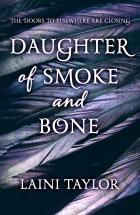
Daughter of Smoke and Bone cover

Daughter of Smoke and Bone came with a non-release cover and a large yellow feather.  I think the release cover is much more attractive with its dark background and metallic feathers in shades of blue and lavender, but the feather got my attention.

daughter of smoke and bone cover

The blurb that accompanied the book talked about how the publisher sent someone a huge distance with a collection of feathers to court and buy Laini Taylor’s novel; this story was intriguing.  I must admit I fell in love with it in the first chapter, when a vampire leapt out on tourists in Prague and….  I won’t spoil it, but it won me over.  Laini’s prose was poetic, inspiring in me a strong desire to visit Prague, a city that, previously, I’d not felt any particular urgency to visit.  I was concerned that the story would be your average YA paranormal romance but it just wasn’t.  I loved it, but I might have missed out if it hadn’t been for the marketing.

rivers of london cover

The Rivers of London cover stood out upon arrival because it was different, not following the current fashions for fantasy stories.  The blurb also lead me to believe – correctly – that it’s an urban fantasy with humour.  I don’t read enough humorous books, so it went to the top or near the top of my TBR pile.  I really enjoyed reading it and the next two in this series.

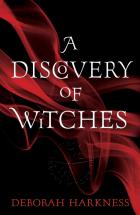
discovery of witches cover

Discovery of Witches arrived as an uncorrected proof with a cover that was later embellished to become the release cover (release cover pictured), wrapped in coarse brown paper hand-stamped with the mark of the vampire’s family.  I kept the paper, carefully folding it and putting it ‘somewhere safe’ so now I can’t find it without a huge hunt.

I don’t know what it is about brown paper – especially coarse brown paper – but I find it really appealing.  It’s tactile.  The wrapping enhances rather than detracts from the book inside.  Tied with string makes it complete and, I think, is romantic without implying that the contents are romantic.

Equations of Life cover

Equations of Life pre-release cover

Equations of Life cover

Equations of Life pre-release back cover

I received Equations of Life (front and rear covers pictured above) and I loved it.  Initially it was the ‘Mind the Gap’ on the front cover that did it, in the same font as the same message written on Metro train platforms.  The blurb on the back cover sold me completely.  When I read Equations of Life, I was heavily influenced by the cover and my desire for some comedy and SF.  The spoofs in the first novel charmed me: references to Doctor Who, zombies etc, kept me entertained.

While I enjoyed all the books in the trilogy, I could see ‘fanfic’ qualities increasingly creeping in over the course of the trilogy.  To give Simon Morden (the author) credit, the protagonist doesn’t have sex with anyone other than his wife but every woman who came into contact with Petrovich, the protagonist, seemed to be in love with him in spite of his complete lack of charisma, his anti-social tendencies and his lack of respect for those around him leading to secrecy and unilateral action instead of team work.

On a second reading of Equations of Life I was much more aware of cringe-worthy aspects of writing, such as love at first sight between Maddy, a nun, and Petrovich leading to Maddy forsaking everything immediately to follow Petrovich and protect him.  Not to mention the dialogue in the early scenes between the two of them – ouch!  Maddy was a lethal killing machine trained to defend her superiors, but she couldn’t drive a car?!  And Petrovich ‘taught’ her? In a manual car in extreme circumstances, all the while talking down to her without equivalent retaliation or smack downs?  Equations of Life is probably a 3 star book, even after a second read through, but my first reading was influenced heavily by the cover, my desire for both comedy and science fiction.

I’m pretty sure I was given the opportunity to review Ash and Huntress by Malinda Lo.  I passed them over because of the covers: they looked like a lot of other YA fantasy covers.  I assumed – incorrectly – that these books would have been similar to a lot of other YA.

Vengeance cover

Vengeance also arrived wrapped in paper, tied with string and with a personal note from Ian himself.  Again, I put this carefully in a ‘safe place’ and now I’m going to have to hunt through all my safe places to find it.

to spin a darker stair cover

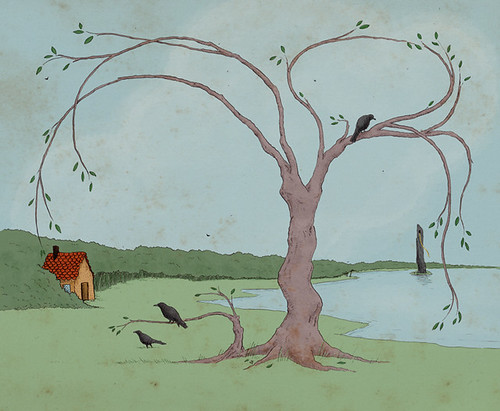
To Spin a Darker Stair cover

To Spin a Darker Stair arrived gift-wrapped in an envelope.  Because the envelope was intended for letters not books, and the wrapping paper was typical gift-wrapping paper, the envelope and paper were torn and the book cover dented.  Presenting this book as a surprise gift worked in that it created curiousity – I wasn’t expecting this book at all – but the book arriving damaged was a little disappointing.

At the end of the day receiving an unknown book from an unexpected source may not have worked in the book’s favour except for a few other factors.  The book design was excellent.  I liked the artwork: a whimsical pseudo-watercolour image (pictured above).  The print size was good: this was very significant as it seems that most Australian short stories are printed in font sizes so minuscule I struggle to read them with a magnifying glass (so I don’t read them).  People I knew on Twitter were talking about receiving their copies as well; without this, the total absence of a cover letter or accompanying card may well have backfired.  The book was tiny, so I read it very quickly that evening and I enjoyed it.

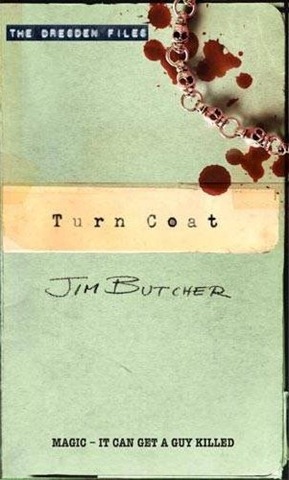
turn coat cover

I first learnt of the Dresden Files at the Melbourne Science Fiction Club, when they scheduled a night of Dresden Files the TV series.  I purchased the TV series and watched the entire short series, then I went into Dymocks and started purchasing the books.  At that stage, the books were presented with matt covers styled like old-fashioned manilla files with slightly scrap-book-ish touches.  As Harry Dresden, the protagonist, is a wizard who fries electronic equipment with his magic, these covers imbued the paperback novels with an ambience lacking in the more recent covers that have followed the latest fashions in book covers (see below).

turn coat cover

Another issue I have with changing the covers part way through a series is it detrimentally impacts on the presentation of the set on my bookshelf; I have a variety of book covers in this series, it doesn’t look like a set at all.

I admit I’m shallow: I judge a book by its cover and its presentation.  It’s not the only factor in my decision to read a book or its order in my TBR pile: research for interviews, previous writing history, personal recommendations and my mood at the time of book selection all factor in as well.  Books that look ordinary, like every other fantasy book on the shelves or like CGI SF games, are less likely to attract me than creativity in presentation.  Instead of following fashion, I recommend that publishers look at current fashions and do something different.

UPDATE:  On twitter, John Birmingham said: Help design my book cover for the UK release of Without Warning. Win yourself The Disappearance Trilogy audiobooks http://www.cheeseburgergothic.com/archives/3703

without warning cover

This is the Australian cover.  Any thoughts? The advertised price sticker is attractive and the 50 books you can’t put down sticker doesn’t get slapped on everything, but the cover doesn’t really grab me apart from that.  I really enjoyed Birmo’s World War 2.0 trilogy, so I’m interested in principle, the cover doesn’t need to grab me.  Thoughts?

Kim Westwood

Kim Westwood

Kim Westwood


Kim Westwood talked to Dark Matter on Thursday about her career and her award-winning stories including the latest, Courier’s New Bicycle.

Lucy Sussex described Kim’s work: ‘… mixes ecological disaster with religious cults, Mad Max with feminism…Kim is a stylist, with a line in lyricism, and a nice sense of humour … [Kim’s novels are] richly peopled canvas[es], of which perhaps the real star is the ravaged landscape, so intensely depicted as to be almost a presence.” – The Age, Nov. 2, 2008

Courier’s New Bicycle is must-read speculative fiction.

Trust Me Too

By Deb Gates

Isobelle Carmody and Michael Pryor

Isobelle Carmody and Michael Pryor with friend

I was lucky enough to attend the launch of Trust Me Too, a new anthology edited by Paul Collins, on the 27th of July. Trust Me Too is 466 pages of amazing writing and illustrations by fifty seven talented Australian writers and illustrators; about half of whom turned up on the night.

The launch was held at the Princes Park secondary college in Melbourne. The kids of the school, along with library staff, won the honour of hosting the event after entering a competition. The night started with some great music performed by year seven students from the school, with other students playing host, offering a scrumptious array of nibblies and drinks. Opening the launch, two of the ‘Sloths’ (the school’s student library group) introduced the guests. Paul Collins added a few words then invited  Meredith Costain to read her wonderfully witty poem ‘Shoefiti’. Isobelle Carmody followed this with a snippet of her novella, ‘The Journey’, before officially launching Trust Me Too by cutting the ceremonial ribbon.

Those lucky enough to be in attendance were able to purchase the book and have it signed by the twenty odd contributors. Conversation flowed as fans met their favourite authors and illustrators. I had a little fangirl moment when I introduced myself to Michael Prior and asked for a photograph.

The amazing thing about Aussie writers is the amount of time they are willing to give their fans.  They were all more than happy to chat, sign books and bookmarks and have photos taken. Trust  Me Too has something for everyone: fantasy, Sci-Fi, poetry, graphic novels, romance, some horror, adventure and crime, and lots more, along with incredible illustrations. If you don’t already have a copy you should rush out and get one.

the signing lineup

the signing lineup

Return to home page

The Courier’s New Bicycle: a review

Author: Kim Westwood
Publisher:  HarperVoyager
Reviewer:  Nalini Haynes

courier's new bicycle cover

In Melbourne in the near future the right wing has taken power, followed by state-sanctioned religion promoting discrimination and even attacks on non-conformists.  During a lethal influenza epidemic, inoculations were diluted with a drug later found to cause sterility.  The Courier’s New Bicycle is set about 8 or 10 years later when the ramifications have begun to be felt, rippling into the political sphere, but before infertility escalates to Children of Men proportions.  This situation would not be as severe as in Children of Men as some women are still fertile, but pregnant women aren’t sacred in this society and babies aren’t being bought from overseas at astronomical costs – yet.

Salisbury Forth – called Sal by her friends – is androgynous and same-sex attracted although probably bi-sexual.  Born female, Sal’s experience growing up is one of ambivalence to gender stereotypes, not fitting with traditional roles.  Sal works as a courier for a stuffed toy company whose special clients have extra-special stuffing in their toys: instead of drugs to get you high, they have drugs to increase the likelihood of fertility.  Someone starts trading tainted hormones under Sal’s boss’s label, so Sal is roped in to investigate.

The Courier’s New Bicycle is part Friends and part accidental detective story, but what sets it above most other novels is the nature of the world-building and unusual characters.  Westwood has taken the politics of right-wing ‘First’ parties and mixed in the religious politics of the US and the Mad Monk.  Not satisfied with that potent blend, Westwood adds the politics of non-traditional sexuality; In this brave new world, the pendulum has swung back to traditional 50s-style stereotypes and gender ideals; curvaceous women and muscular, lantern-jawed men.  To be different is to be ostracised at best, or targeted for physical violence and worse.  As Sal and her non-traditional friends need to fly under the radar to survive, the drugs and Sal’s investigation puts them at greater risk.    Westwood takes current attitudes and extrapolates from currently informally segregated waterholes into prohibition-style speakeasy joints for the differently-oriented.  In one scene Sal and her girlfriend go out on a date, ‘passing’ as normal, just as half-castes or disabled persons talk about ‘passing’.  Incredibly powerful, this plot thread takes this novel into a class of its own while raising the stakes to add to the suspense.

The Courier’s New Bicycle is a masterpiece; I haven’t felt this way about a work since Wings of Desire.  Highly recommended; this is brilliant speculative fiction not to be missed.

There are a few explicit sex scenes in the novel however they are fairly brief.

Cuttlefish: a review

Author:  Dave Freer
Publisher:  PYR
Reviewer:  Nalini Haynes

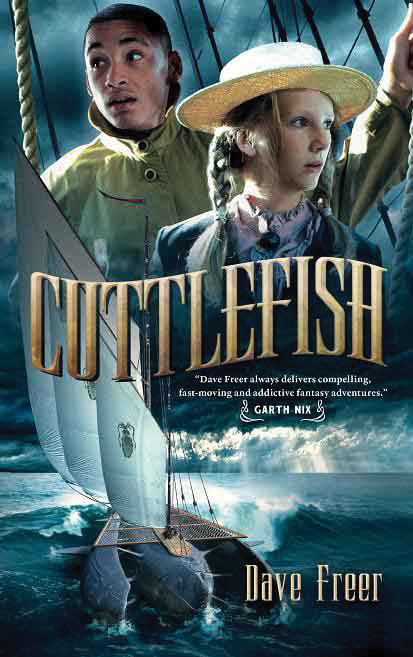
Cuttlefish cover

Cuttlefish is a speculative fiction YA book set in a not-too-distant past alternate history where rising sea levels have flooded London, converting that city into a new Venice.  Clara Calland, a teenager at boarding school, absconds with her mother who is being hunted by government and anti-government groups.  Tim, a teenage boy from the impoverished tunnels of London, has signed on to the Cuttlefish as crew.  The Cuttlefish is a submarine with catamaran capabilities that alternately runs on coal, electricity or wind power, depending on the circumstances.  Fully crewed, the submarine has a traitor on board.  No-one listens to Clara or Tim, so they investigate on their own with dire consequences.

Dave Freer has built an intricate alternate-history world with steampunk themes.  The British Empire remains strong in spite of excessive use of coal leading to premature rising of sea levels; world politics and geography varying accordingly.  The detail that goes into Freer’s descriptions of running Cuttlefish, including converting the submarine to sail power and hydro-foils, is incredible.  Likewise, the detailed world-building is immersive; Freer has translated authentic history into this alternate world with a differing political agenda.

The plot has four main threads: 1) a very chaste romance between Clara and Tim, young love at its most naïve and endearing, 2) Clara’s discovery of world politics including her parents’ roles in a rebellion, 3) a chase scenario where the various groups are hunting Clara’s mother hunt down in Cuttlefish and 4) the traitor on board, his actions and consequences.  I’d prefer a little less focus on the actual sailing and hiding.  I felt it was hard to maintain my suspense in some sequences, but then I’m one of those heretics who found 20,000 Leagues Under the Sea deathly dull: perhaps I just have a very short attention span.  The other plot threads are engaging, the characters are interesting and they develop throughout the novel as do their relationships.  I can easily visualise Cuttlefish as a beautiful colour graphic novel or even a Hunt for Red October-style movie.

Cuttlefish is a kind of coming-of-age story in that Clara and Tim are both in the process of growing up and re-evaluating their places in the world.  So many stories of this genre use generation disconnect tropes and seem to leave you with the feel of ‘it’s over, they’ve grown up’ at the end, which is very superficial.  Freer explores themes of generational disconnect and relationships by balancing possible rebellion against the necessity of relationships, alongside the knowledge that the teenagers don’t have all the answers.  Clara and Tim’s relationship and coming of age is a story of transition with a hope for the future but it’s not an end in itself.  It’s not clear whether Freer intends to write more in this series; the open ending leaves room for more, or for the reader to imagine their own future.

Billed as a YA novel for ages 12 and up, I recommend Cuttlefish for primary students with an appropriate reading age as well.  Cuttlefish  is recommended for fans of YA spec fic, sailing, steampunk and alternate history, for older children, teens and the young at heart.