Reviews

I was seriously ill for a month with flu then pneumonia.  During this time I managed to do some reading but I couldn’t string string together sentences worth a damn so a pile of books for review accumulated.  Since I got better I’ve had dramas galore and I’ve been procrastinating.  I hate missing a deadline, so if there isn’t anything I can do about it, I tend to bury my head in the sand by pretending the deadline didn’t exist.  I know this is crazy as I’m the only person setting deadlines for Dark Matter, but I never claimed to be logical like Spock.  This is why these reviews are coming in a flood now: I am officially and really catching up. :P

Starting at the top of the pile, so in reverse order:

The Outcast Blade cover

The Outcast Blade by Jon Courtenay Grimwood.
A historical paranormal fantasy with Machiavellian politics, adventure, werewolves and romance, set mostly in Venice, Italy in about the 17th century or thereabouts (my history is rusty).  I loved the first in this trilogy; setting werewolves in a historical setting gave them a freshness: urban fantasy with werewolves is getting a bit same old, same old.  Grimwood created such a sense of place that Venice was almost a character in her own right, although I’ve been assured by friends who’ve been that the city stinks to high heaven.  The smell doesn’t quite come through. ;)

I am somewhat confused about what Tycho, the male protagonist, is.  Sometimes it seems he’s a vampire and at other times he seems to be a werewolf, but he’s not the same creature as others who are definitely werewolves.  It could be that Tycho’s self-discovery is made alongside the reader, which is why I haven’t Wikipedia’ed or googled it.  I try to avoid spoilers where practical.

The second in the series was a really good Act II, well paced, carrying the plot forward, developing the relationships further.  My only criticism is Grimwood’s habit of splitting sentences in two. So there’s a full stop between clauses.  I found this quite distracting.  Act I was reviewed from an ARC (Advanced Reader Copy) but Act II wasn’t an ARC so criticisms of the text are fair.

The hiatus at the end of Act II is a good one, with a partial resolution to tide the reader over until next year.  I think this series will appeal to Game of Thrones fans although it’s not as hefty nor does it have as many characters.  Highly recommended.
Legacy of Lord Regret cover

The Legacy of Lord Regret by Sam Bowring (whom I interviewed) is high fantasy with black and white characters who are almost caricatures.  While I prefer characters who are shades of grey (as in Sam’s first trilogy, apparently) these characters are interesting because when they kill one another they absorb the victim’s power – and part of their personality.  Thus Sam’s characters are changing, and those changes aren’t just incidental as a result of the plot, they are instrumental and will, I expect, cause shifts in the plot.   This is book one of a duology (two book story arc).  The second book is the Lord of Lies, which is also out, so no waiting on the conclusion to this story – unless you’re a reviewer/interviewer trying to keep up.  My copy is in my TBR pile.

The nature of this novel is such that I need to read the conclusion to decide how enthusiastic I am about it: I really want surprises, twists and more greyness, but in its present form it’d make a popular comic book or movie.

If you’re trying to decide whether to give this one a go, I recommend listening to Sam’s interview.  (Note: Sam had the flu so his energy levels were low.)  Sam talked about how his favourite character was the guy who tortures people, and that’s played for comedic value.

The Drowned Cities cover

The Drowned Cities by Paolo Bacigalupi is another book set in a world not unlike Windup Girl, which I loved. Drowned Cities is the story of two teenagers.  Mahlia is a half-caste who had her right hand chopped off, and Mouse is an optimistic kid who rescued Mahlia before the story began.  They accidentally disturb Tool, a genetically engineered soldier who is part human, part animal.  The story is set in southern USA after climate change has caused seas to rise.  The remnants of their world are not unlike war-torn areas in Africa or the Middle-East, creating both the setting and the plot for this story.  Bacigalupi brings this culture of war to life vividly, challenging people to think, to really think, about what is going on in the world today.  Highly recommended dystopian SF.

deadlocked cover

Deadlocked by Charlaine Harris is the second-last in her Sookie Stackhouse series upon which True Blood is loosely based.  It’s paranormal fantasy with werewolves, vampires, shapeshifters, fairies, witches, telepaths, you name it.  Sookie, her family and friends have been through lots of adventures, murders, threats, sex, drugs and rock’n'roll.  As the second-last in the series, Charlaine has been wrapping up story lines, closing off characters and she’s leading in to the final story.  I’m looking forward to the conclusion.

This is not a ‘jumping on’ point for the series; if you are a newcomer, I recommend you start with book one.  Overall if this series was food, it’d be chocolate; it’s overall light and escapist fun.

Songs of the Earth cover

Songs of the Earth by Elspeth Cooper is epic escapist high fantasy based on Nordic mythology about the Wild Hunt.  The protagonist, Gair, is a young man of mysterious origins with extraordinary magical powers.  Narrowly escaping a death sentence due to political machinations by people he’s never met, Gair travels to an academy for students of magic where he makes friends for the first time and aggravates new enemies.

The hero with obscure origins finding himself, a forbidden romance, betrayal from within, destiny: these are common tropes reflecting influences from a variety of beloved authors.  Elspeth weaves these threads together well, appealing to fans of iconic authors who’ve been waiting for another high fantasy ‘fix’ and to fans of fantasy who haven’t read those who’ve gone before.  Children who enjoyed Alan Garner’s The Weirdstone of Brisingamen and Ursula le Guin’s Earthsea series (the books, not the Anime nor the TV series) will enjoy Elspeth’s Wild Hunt as adults.

Songs of the Earth is so popular it was shortlisted for a Morningstar Award  in 2012, which is a ‘best fantasy’ award for a new author.  Book two, Trinity Rising, is out already.  I think book three is due out next year.
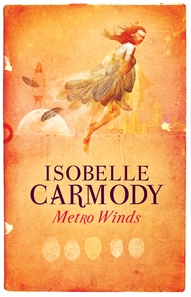
metro winds cover

Metro Winds by Isobelle Carmody is a series of fairy tales for a YA or adult market (not for children), presented as short stories and one novella in one volume.  Most of these are original stories with one notable retelling of a classic tale, reimagined in the most creative way I’ve read to date.  It’s very difficult to talk about short stories without giving away spoilers so I recommend listening to Isobelle’s author talk and reading for more information: she presents Metro Winds beautifully, better than I, plus – added bonus – she explains why it’s been so hard for her to finish the Obernewtyn Chronicles.

I thoroughly enjoyed these tales even though I’m usually dissatisfied with the brevity of short stories.  My only reservation was one of the later stories with a male protagonist, which somewhat repulsed me, but others will rave about it.  Highly recommended.
shadow of night cover

Shadow of Night by Deborah Harkness is the sequel to the best-selling Discovery of Witches.  Discovery is fantasy set in contemporary times with vampires, witches, daemons and all sorts of other supernatural folk.  Discovery ensnared me in the beginning with Diana Bishop, an academic, researching in the Bodlean Library in Oxford.

By the end of Discovery I had a few reservations due to what I felt was excessive introduction of magic: Diana’s house was sentient and had ghosts.  Although Diana was supposed to have grown up ignorant of the supernatural, she apparently had a relationship with this house knowing about its magical abilities and habitually magically disposed of her hair and nail clippings to prevent people finding her DNA.  Nonetheless, Discovery captured me and carried me through its romance and wild ride.

In Shadow the protagonists, Diana Bishop (a witch) and her husband Matthew Clairmont (a vampire) travel back in time to Elizabethan England so that Diana can find a mentor to teach her to control her budding powers.  Instead of staying focused, Diana and Matthew hare off after a missing text with the intention of securing it and taking it forward in time.  Although they’re intelligent people, Diana and Matthew ignored all the problems and potential paradoxes inherent in what they were doing.

I love time travel stories and I’m happy for them to engage with paradoxes or to circumnavigate paradoxes, so I’m very forgiving.  The problem with Shadow is the puppet master feel of so many events.  Mary, Diana’s new friend, shows up in the nick of time unexpectedly and does exactly the right thing without legitimate foreknowledge or a reasonable explanation afterwards. Phillipe, Matthew’s father, gives Diana a really hard time then suddenly does a backflip without justification for the contrasting behaviour.  I felt that Diana and Matthew lingered too long in historical Europe just to place them in a parade of historical events and European courts, winking at the reader all the while.

A year ago I would have read Shadow of Night, recognised some of its flaws and still loved it unashamedly.  This year I enjoyed it but that critical faculty switched on during reading made me almost feel guilty for enjoying it, puppet masters and all.

If you enjoy full on magical fantasy populated with a myriad of supernatural folk plus a generous dollop of historical fiction thrown in, and you’re happy not overly analysing the story, then Shadow of Night is a highly recommended read.  Just throw yourself in and enjoy the ride.
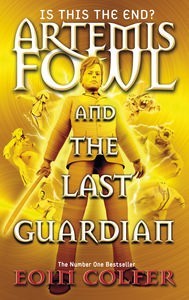
Artemis Fowl and the Last Guardian cover

Artemis Fowl and the Last Guardian by Eoin Colfer is the final in the comedy adventure Artemis Fowl series that my son grew up with, reading and rereading since primary school.  Of all the books my son read growing up, this series stands out as a series he still loves without reservation, aged 19.  I’ve read the full series as well, although not nearly as many times.

Artemis Fowl is a boy genius who grew up in a crime family.  After kidnapping a fairy, Captain Holly Short of Leprecon – the fairy police – the following adventures build an uneasy truce and later friendship between Artemis and the fae.  In this, the final instalment of the series, Artemis is on the cusp of adulthood.  As with Harry Potter, Artemis and his adventures have ‘grown up’ over the course of the series, aiming at a little higher age group, but I think the later books are still suitable for advanced primary school readers.  I think the entire Artemis Fowl series is suitable to be read to children too young to read themselves as stories like these will inspire a love of books.

Every Artemis Fowl book looks at current issues in the world, often from a a conservationist perspective without being preachy.  This final book explores the idea of obsolete conflict – like the Japanese soldiers stranded after World War II, still fighting the war because no-one told them it was over.  Eoin discusses this in our interview.  As always, Mulch Diggums (a very original dwarf) farts his way through adventures, slap-stick comedy routines abound like parts falling off zombie minions at inconvenient moments, camaraderie and high jinks abound.

I’ve enjoyed this series so much so that I recommend it to adults even if you don’t have children to whom you read.  If you read stories to children, this series is a must have.
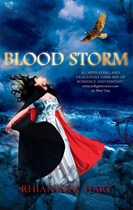
blood storm cover

Blood Storm by Rhiannon Hart is a YA paranormal romance starring Zeraphina, a princess whose older sister married the crown prince of another country, and Rodden, a commoner who rose to a position of power very young.  Both Zeraphina and Rodden have been infected with the blood of Lharmellians, the precursor to turning them into Harmings (human vampires).  As Zeraphina and Rodden struggle with side effects and struggle to remain human, retaining their will, they are intent on opposing Lharmellians and Harmings, whose politics may be more complex than they first appeared in Blood Song, the first in this trilogy.

In this, the second novel in the trilogy, Zeraphina and Rodden do a Cook’s tour of the countryside, learning more about each other and the Lharmellian conflict.  Blood Storm has an episodic feel as if written for TV and the different locations are the ‘location of the week’.  I particularly enjoyed the trip into the desert, which wasn’t just an excuse to feature belly dancing.  ;)

Zeraphina is pursued by a prince of another country to be his bride.  This courtship is my least favourite portion of the book as the prince is a bit of a caricature villain, missing only twirling black mustachios, but it’s a small portion of the story.

Revelations of Rodden’s past confirm that he’s not some mysterious prince in disguise, a somewhat time-worn trope.  Rhiannon has more revelations planned for book three, which she discusses, at least in part, when she talked to me just before Blood Storm‘s launch in August.

Blood Song is an original, captivating YA paranormal romance.  Blood Storm is not quite up to the same standard, but it’s still a solid second book for a new author.  I look forward to reading the conclusion.

whispers underground cover

Whispers Underground by Ben Aaronovitch is an urban fantasy comedy with Harry Potter-esque Peter Grant working as a policeman in contemporary London.  I started this review when I only had the flu, before it developed into full-blown pneumonia, but I didn’t quite manage to finish it.  Here goes:

Peter Grant works in The Folly, which is a special branch of London Metropolitan Police dealing with the supernatural in present-day London so everyone else can live in denial.  Lesley May, his cop-buddy and erst-while lust-interest, had her face ripped off in a previous novel.  Although Lesley is still intelligent, more capable than Peter and physically attractive apart from her lack of face, Peter has issues about Lesley’s looks.  Peter is shallow and somewhat slow on the uptake, as evidenced by Lesley overtaking Peter in magical studies as well as always having been the better police officer.    Although technically on medical leave, Lesley is actively involved in this novel to some extent.

Whispers Underground is a detective policing story told from Peter’s point of view; Peter is summoned to investigate a murder with a hint of magic.  Peter meanders around, furthering the investigation partly through luck, partly through his increasing skill and partly with the help of old friends.

Peter, like Aaronovitch, is a bit of a geek fanboi, so his detailed knowledge of architecture and the intricacies of London are woven into the story alongside countless one-liners spoofing geek culture with an emphasis on Lord of the Rings.  This is Big Bang Theory without making a mockery of the geeks, although a little more respect for Lesley – and, by default, for all women – would be appreciated.  At times Peter has the maturity of a teenager while at other times he’s considerate and thoughtful: I hope that this minor story thread is part of Peter growing up.

The humour ranges from dry one-liners to somewhat slap-stick physical comedy to intricate social comment like the reporting about Asylum seekers eating a snow plow (you have to read it!); thus Aaronovitch successfully casts a net for a wide audience.  I’m really enjoying this series.  Highly recommended as urban fantasy comedy adventure thriller.

I also expect romance to come later, when Peter gets his head out of that very dark place upon which he sits. :P  Although it’d probably have to be initiated by Lesley.
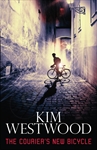
The Courier’s New Bicycle: a review

Author: Kim Westwood
Publisher:  HarperVoyager
Reviewer:  Nalini Haynes

courier's new bicycle cover

In Melbourne in the near future the right wing has taken power, followed by state-sanctioned religion promoting discrimination and even attacks on non-conformists.  During a lethal influenza epidemic, inoculations were diluted with a drug later found to cause sterility.  The Courier’s New Bicycle is set about 8 or 10 years later when the ramifications have begun to be felt, rippling into the political sphere, but before infertility escalates to Children of Men proportions.  This situation would not be as severe as in Children of Men as some women are still fertile, but pregnant women aren’t sacred in this society and babies aren’t being bought from overseas at astronomical costs – yet.

Salisbury Forth – called Sal by her friends – is androgynous and same-sex attracted although probably bi-sexual.  Born female, Sal’s experience growing up is one of ambivalence to gender stereotypes, not fitting with traditional roles.  Sal works as a courier for a stuffed toy company whose special clients have extra-special stuffing in their toys: instead of drugs to get you high, they have drugs to increase the likelihood of fertility.  Someone starts trading tainted hormones under Sal’s boss’s label, so Sal is roped in to investigate.

The Courier’s New Bicycle is part Friends and part accidental detective story, but what sets it above most other novels is the nature of the world-building and unusual characters.  Westwood has taken the politics of right-wing ‘First’ parties and mixed in the religious politics of the US and the Mad Monk.  Not satisfied with that potent blend, Westwood adds the politics of non-traditional sexuality; In this brave new world, the pendulum has swung back to traditional 50s-style stereotypes and gender ideals; curvaceous women and muscular, lantern-jawed men.  To be different is to be ostracised at best, or targeted for physical violence and worse.  As Sal and her non-traditional friends need to fly under the radar to survive, the drugs and Sal’s investigation puts them at greater risk.    Westwood takes current attitudes and extrapolates from currently informally segregated waterholes into prohibition-style speakeasy joints for the differently-oriented.  In one scene Sal and her girlfriend go out on a date, ‘passing’ as normal, just as half-castes or disabled persons talk about ‘passing’.  Incredibly powerful, this plot thread takes this novel into a class of its own while raising the stakes to add to the suspense.

The Courier’s New Bicycle is a masterpiece; I haven’t felt this way about a work since Wings of Desire.  Highly recommended; this is brilliant speculative fiction not to be missed.

There are a few explicit sex scenes in the novel however they are fairly brief.

Cuttlefish: a review

Author:  Dave Freer
Publisher:  PYR
Reviewer:  Nalini Haynes

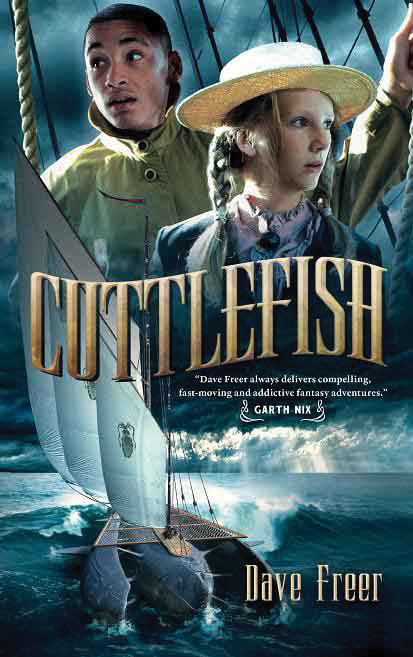
Cuttlefish cover

Cuttlefish is a speculative fiction YA book set in a not-too-distant past alternate history where rising sea levels have flooded London, converting that city into a new Venice.  Clara Calland, a teenager at boarding school, absconds with her mother who is being hunted by government and anti-government groups.  Tim, a teenage boy from the impoverished tunnels of London, has signed on to the Cuttlefish as crew.  The Cuttlefish is a submarine with catamaran capabilities that alternately runs on coal, electricity or wind power, depending on the circumstances.  Fully crewed, the submarine has a traitor on board.  No-one listens to Clara or Tim, so they investigate on their own with dire consequences.

Dave Freer has built an intricate alternate-history world with steampunk themes.  The British Empire remains strong in spite of excessive use of coal leading to premature rising of sea levels; world politics and geography varying accordingly.  The detail that goes into Freer’s descriptions of running Cuttlefish, including converting the submarine to sail power and hydro-foils, is incredible.  Likewise, the detailed world-building is immersive; Freer has translated authentic history into this alternate world with a differing political agenda.

The plot has four main threads: 1) a very chaste romance between Clara and Tim, young love at its most naïve and endearing, 2) Clara’s discovery of world politics including her parents’ roles in a rebellion, 3) a chase scenario where the various groups are hunting Clara’s mother hunt down in Cuttlefish and 4) the traitor on board, his actions and consequences.  I’d prefer a little less focus on the actual sailing and hiding.  I felt it was hard to maintain my suspense in some sequences, but then I’m one of those heretics who found 20,000 Leagues Under the Sea deathly dull: perhaps I just have a very short attention span.  The other plot threads are engaging, the characters are interesting and they develop throughout the novel as do their relationships.  I can easily visualise Cuttlefish as a beautiful colour graphic novel or even a Hunt for Red October-style movie.

Cuttlefish is a kind of coming-of-age story in that Clara and Tim are both in the process of growing up and re-evaluating their places in the world.  So many stories of this genre use generation disconnect tropes and seem to leave you with the feel of ‘it’s over, they’ve grown up’ at the end, which is very superficial.  Freer explores themes of generational disconnect and relationships by balancing possible rebellion against the necessity of relationships, alongside the knowledge that the teenagers don’t have all the answers.  Clara and Tim’s relationship and coming of age is a story of transition with a hope for the future but it’s not an end in itself.  It’s not clear whether Freer intends to write more in this series; the open ending leaves room for more, or for the reader to imagine their own future.

Billed as a YA novel for ages 12 and up, I recommend Cuttlefish for primary students with an appropriate reading age as well.  Cuttlefish  is recommended for fans of YA spec fic, sailing, steampunk and alternate history, for older children, teens and the young at heart.

Trouble Twisters The Monster: a review

Trouble Twisters: The Monster
Authors: Garth Nix and Sean Williams
Publisher: Egmont
Reviewer: Nalini Haynes

Trouble twisters 2 cover

Jack and Jaide are non-identical twins living in the small town of Portland, which has its very own monster. Jack and Jaide are troubletwisters, teenagers growing into their supernatural powers, eventually destined to become wardens whose role is to protect others. Tara, the other new kid in school, becomes their friend while the twins use their amateur sleuthing skills to prove that Tara’s father is Evil incarnate that must be destroyed. Just as teenagers have difficulties with hormones, these teenagers have difficulty controlling their powers. Their powers run amok, the only solution being for them to know themselves, accepting their strengths and weaknesses.

Grandma X, the twins’ caregiver and mentor, has two cats who talk to the twins when the cats aren’t miffed. Jaide and Jack’s mum works three-day shifts at the hospital and has been enchanted, giving the twins freedom to move in this paranormal world while they learn to use their powers, find out what is meant by one twin always falling, and combat the Evil that is trying to gain entrance into their world. Instead of the adults being removed from the picture – a common mechanism to enable minors the freedom to have adventures – the twins must balance their relationships with the adults in their lives.

In the first Trouble Twisters book, Jack and Jaide discovered their abilities and had adventures that resulted in blowing up their home. They and their mother moved to Portland to live with Grandma X, only to discover that one of the wards in Portland was in need of repair. They managed to repair the ward and started attending a new school. At the beginning of book two they’ve been at the new school for a week when another new kid, Tara, told the kids at school she may have seen a monster.

Trouble Twisters is a well-written paranormal urban fantasy with two great advantages over a lot of similar literature. Firstly, the teens are cared for by adults in their lives with whom they may have disagreements – both sides being in the wrong at various times – but with whom they continue to have relationships. This is much more constructive and interesting than the Harry Potter-esque Muggle trope where Harry’s family don’t understand him because they’re mundane and abusive. In contrast, the shades of grey in Trouble Twisters lead the reader on, deepening the mystery and expanding possibilities in this and future instalments in the series.

Secondly, this is a novel written by two men, starring a male protagonist who is equal to his female counterpart and cared for by a Granny Weatherwax-type. Thus this is a rare series that can appeal to both boys and girls equally. I think Williams and Nix have carried this off successfully, even with the introduction of a third youth who is female. The dynamics of the three-way relationship – the twins’ bond, the girls’ friendship, the potential love-interest in its sweetest infancy – are believable and engaging. Trouble Twisters has the potential to build bridges, helping the young develop healthier attitudes towards representations of gender while avoiding harmful stereotypes. More of this, please.

Trouble Twisters: The Monster is a paranormal urban fantasy. I suspect it’s aimed at the younger end of the YA market, but it’s an excellent read for younger children with sufficient reading skills. Highly recommended for children, teens and the young at heart.

Arrietty: movie review

Arrietty
Studio Ghibli
Reviewed by Nalini Haynes

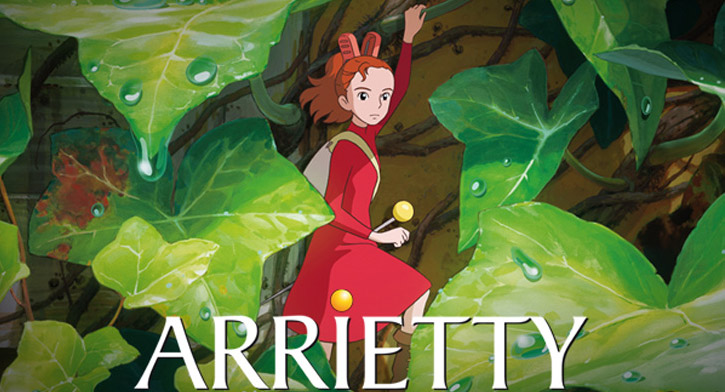
Arrietty dvd cover

Arrietty is a Borrower, a little person who lives with her parents under the floor of a house, borrowing small items like sugar cubes and little morsels of food that humans would never notice going missing.  Arrietty is seen by a boy, Shawn, who talks to his aunt in front of Haru, the housekeeper, about little people.  Haru decides to hunt down the little people to get rid of them, regardless of her employer’s wish for the little people to live in her dollhouse. The opening scenes build Arrietty’s world effectively, demonstrating her size, how she lives and what dangers she faces.

The plot is well-paced but gentle.  Haru begins investigating, her goals made clear when she calls in pest control.  She’s just a woman who wants to be rid of thieving pests, she’s not a terrifying villain.  Shawn is ill but gains hope and courage from Arrietty; this is possibly the weakest point of the plot but it’s a positive message to family audiences.  This is a movie that is suitable for very young viewers, a family movie.

The movie is animated: the characters are drawn as line and colour figures, reasonably accurate proportions with eyes emphasised for characterisation.  Some of the landscapes are painterly representations of luxuriant flowers and scenery.

When I was 9 and 10 years old, I read and reread every one of Mary Norton’s Borrower series that I could find in the school library.  Revisiting this story now had special meaning for me, although some things made me pause for reflection.  Arrietty is set in Japan, with subtle reminders including wooden floorboards, humans wearing slippers inside and wooden clogs outside and the architecture of the house is somewhere between traditional Japanese and a more Western style of home.  A human using a mobile phone was another reminder that Arrietty is made in a different era to the one in which the Borrowers originally lived.  While my memories of the Borrowers stories have faded with time, I’m fairly confident in saying that Arrietty is an adaptation: this plot was not true to an original novel.  Arrietty is a successful interpretation of the original stories for a new generation; I hope that young readers will discover Mary Norton’s books and delight in them as much as I did, as a result of Arrietty the movie.

I highly recommend Arrietty as a family movie and as an effective adaptation of the Borrowers.

Bitter Greens: a review

Bitter Greens by Kate Forsythe

Review by Nalini Haynes

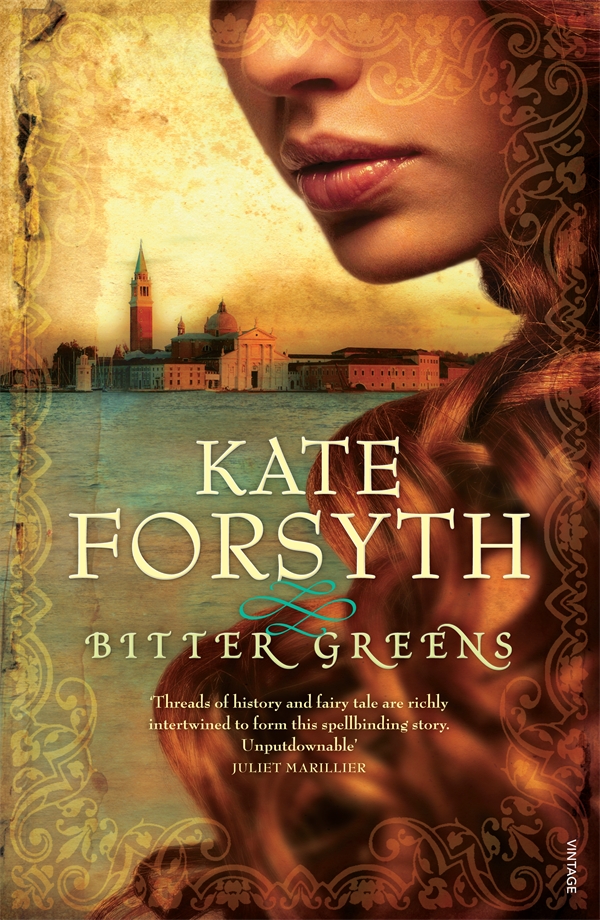
Bittergreens

Bitter Greens is a well-researched retelling of the Rapunzel fairy story as well as the history of the fairy story.  Set in what appears at first glance to be historical France and Italy, Bitter Greens has real magic woven into the fabric of the world as well.

Charlotte-Rose is a Hugenot in the seventeenth century, a time of political persecution of Hugenots, with the capricious Sun King of France and his court descending on the homes of families who struggle to meet his expectations for lavish hospitality, then suffer at his whim.  Having lost her mother at the whim of the King, Charlotte-Rose goes to court as a lady-in-waiting, a career mixing success with scandal.  Imprisoned in a convent at the whim of the King, Charlotte embarks on a journey of self-discovery, recounting her story episodically, counterpointed by the story of Rapunzel, told to her by another nun.

Rapunzel’s story is set in Italy the previous century.  A girl is taken from her parents by a witch and locked in a tower.  At first it appears that this is the story of the girl, but later it becomes the story of the witch.  Going back further in time the reader learns there have been a string of girls used by the witch to retain her beauty, while aspiring to immortality.

As with many fairy stories involving women, Bitter Greens is a story about women living in a man’s world, how the women respond to limitations imposed upon them by society and the lengths to which they are prepared to abuse other women in order to achieve their goals.  The machinations and manipulations of the witch in the Rapunzel tale and the women in the court of the King of France are appalling.  The moral of the tale is that such machinations and manipulations have a price that rebounds on the perpetrator, while redemption lies in repentance and service.

Issues of fashion and self-mutilation for ideals of beauty are barely touched upon in Bitter Greens, which seemed to me counter-intuitive to this story about women.  Belladonna eyedrops were used in Bitter Greens along with a passing mention of the risks involved, but not the pain or detrimental impact upon vision.  I found this confronting: when I was very young, my father told me the eye drops given to me by an ophthalmologist were belladonna, formerly used as a beauty treatment.  This was in response to my bitter complaints about visiting the ophthalmologist yet again, the pain and suffering I endured with the eye drops (they’re a lot less painful and detrimental these days, thanks to developments in modern medicine).  I demanded to know why belladonna eye drops were a beauty treatment: my father explained that the eye drops enlarge the pupil of the eye, which was considered beautiful.  Later when studying psychology I learnt that pupils dilate when someone is interested in a topic or person; when Jane is interested in Jack, Jack will often consider Jane more attractive.   I suspect my father was trying to placate me in the face of the inevitable, but he only succeeded in sowing the seeds of my life-long issues with beauty and the fashion industry.  I personally wanted more exploration of the suffering women endured to achieve ideals of fashion and beauty, suffering endured while seeking approval from men.

I thoroughly enjoyed 3/4 or more of Bitter Greens, which I’d possibly rate as 5 stars, but I had issues with the final quarter.  Overall, I give Bitter Greens 4 stars.  Major Spoiler alert!  Don’t read ahead if you don’t want end of novel spoilers.  Towards the end, Charlotte’s story was patchy: she loved and lost her husband, but the seeds of the romance were omitted entirely.  The reader jumps in to that portion of her life after the romance had begun.  There were other portions of her story that were likewise patchy.  The Rapunzel story followed the same plot I read as a child, with one exception: that exception was predictable due to foreshadowing in Bitter Greens.  This exception felt a little pat, a little too convenient for my tastes, but gave a moral to the story while explaining the historical fact of the Italian Rapunzel tale being written in a French convent.  The conclusion of the over-arching story felt a little sudden, a little rushed, after the detailed story-telling and world-building that went before.

Overall, a highly recommended read for people who love fairy stories retold and historical fiction.